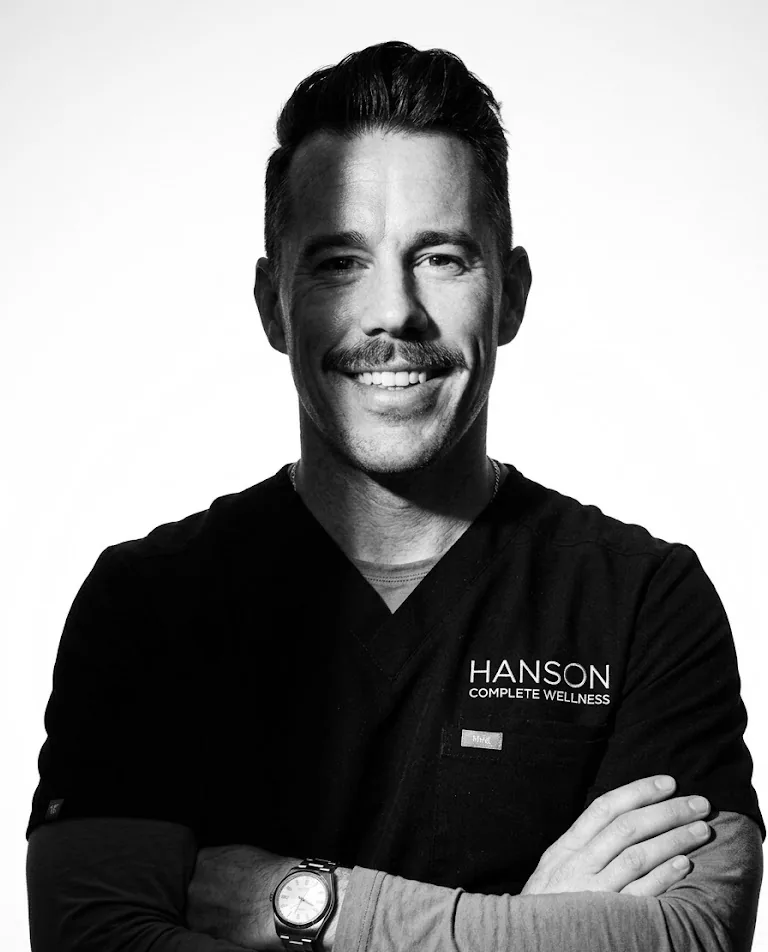
Dr. Josh Hanson, DACM · Tampa, FL
Pain that keeps coming back?
We find what others miss.
Acupuncture · Dry Needling · Shockwave Therapy · Prolotherapy · Regenerative Injections
Neck pain · Back pain · Shoulder pain · Migraines · Sciatica
5.0 Google rating · 35,000+ procedures
Losing vision? MicroAcupuncture — 4 days, measured results →
Not here for pain?
Four days. Measured on a visual field scan. No needles near your eyes.
MicroAcupuncture for macular degeneration, retinitis pigmentosa, glaucoma, and other degenerative eye conditions. Fine needles go in the hands and feet only. We scan your visual field at baseline and again every day, so progress is measured rather than guessed.
Dr. Hanson has performed MicroAcupuncture for over 10 years — one of a small number of providers worldwide.
Your First Visit
The Pain Mapping Visit
You do not need to know whether you need acupuncture, dry needling, shockwave, prolotherapy, or injections.
That is the point of the visit.
We examine the painful area, map the likely tissue creating the signal, treat the target when appropriate, and give you a clear plan.
The Problem
Tried everything, still hurting?
Most people who come here have already tried the obvious things:
Some felt better for a while. Some never got a clear answer. Some had imaging that did not fully explain the pain.
The missing step is usually the same:
Has anyone actually found the tissue generating the pain?
The Method
The Pain Mapping Method
We do not start with the tool.
We start with the exam.
-
STEP 01
Map the pain
Hands-on palpation, movement testing, orthopedic assessment, trigger point evaluation, and nerve sensitivity testing to find the structures most likely driving your symptoms.
-
STEP 02
Treat the target
We choose the tool based on the tissue involved — muscle, tendon, ligament, joint, fascia, nerve, scar, or trigger point.
Depending on your case, care may include dry needling, neurofunctional acupuncture, electroacupuncture, shockwave therapy, prolotherapy, perineural injection therapy, acupotomy, and pharmacopuncture.
-
STEP 03
Recheck the response
Treatment is also diagnostic. We recheck your movement and tender points right after treating — how the tissue responds confirms whether we found the specific source of your pain and what to do next.
-
STEP 04
Build the plan
You leave with a clearer understanding of what is likely driving the pain and what needs to happen next.
What We Treat
Conditions we commonly help with
We work with people dealing with chronic and stubborn pain, including:
- Neck pain
- Back pain
- Sciatica-like pain
- Shoulder pain
- Hip pain
- Knee pain
- Foot and ankle pain
- Plantar fasciitis
- Headaches
- Tennis & golfer’s elbow
- TMJ & jaw pain
- Tendon pain
- Sports injuries
- Nerve irritation
- Trigger point pain
- Scar-related pain
- Old injuries that keep flaring
The Toolbox
The tools are only useful when the target is clear.
We use advanced orthopedic, regenerative, and acupuncture-based therapies. But the tool is not the method. The method is finding the target.
Dry needling & neurofunctional acupuncture
Used for trigger points, muscle guarding, nerve-related patterns, and neuromuscular dysfunction.
Shockwave therapy
Used for stubborn tendon, fascia, ligament, and soft tissue problems that need a stronger tissue-healing stimulus.
Prolotherapy
Used for ligament, tendon, joint, and connective tissue problems where instability or poor tissue repair may be part of the pattern.
Perineural injection therapy
Used when irritated superficial nerves may be contributing to pain, sensitivity, burning, tingling, or persistent discomfort.
Acupotomy
Used for certain chronic soft tissue restrictions, adhesions, and stubborn structural pain patterns when appropriate.
Electroacupuncture
Used to calm pain, improve movement, change muscle tone, and support nervous system regulation.
Prolozone
A powerful ozone-based regenerative injection. It triggers the body’s own repair response in worn or injured joints, ligaments, and tendons — a natural, effective alternative to PRP and stem cells, often at a fraction of the cost.
Trigger point injections
Direct relief for stubborn muscle knots and myofascial pain.
Pharmacopuncture
Targeted point injections — Traumeel, B12, and gentle local anesthetics.
Why This Is Different
The diagnosis names the region. The exam finds the target.
Back pain is not one thing.
Shoulder pain is not one thing.
Knee pain is not one thing.
One person’s pain may be muscle-driven. Another may be tendon, joint, ligament, fascia, nerve, scar, or trigger-point driven.
That is why protocols fail.
The treatment should match the tissue.
Proof
Why patients choose Dr. Josh Hanson
- 10+ years in practice
- 35,000+ procedures performed
- Rated 5.0 on Google
- Florida’s most experienced dry needling practitioner
- Consulted with MLB, NFL & MLS organizations
- Doctor of Acupuncture & Chinese Medicine (DACM)
- Advanced training in acupuncture, dry needling, shockwave therapy, prolotherapy, regenerative injections, and orthopedic pain care
Not Sure?
Not sure what you need?
Good.
You do not need to diagnose yourself. You do not need to pick the right treatment. You do not need to know whether the problem is muscle, tendon, ligament, joint, nerve, fascia, or scar tissue.
That is what the Pain Mapping Visit is for.
If your case fits this approach, we build a plan. If it does not, we tell you.
Questions
Frequently asked questions
Is this just acupuncture?
Do you treat the same day?
Do I need imaging first?
What conditions do you treat?
What treatments do you use?
How many visits will I need?
Your Next Step
Stop guessing where the pain is coming from.
You do not need another random treatment. You need a clearer map. Your first visit is designed to identify the pain-generating tissue, treat the target, recheck the response, and give you a plan.
Come in confused. Leave with clarity, targeted care, and a path forward.
Visit the clinic
Contact
Hanson Complete Wellness1202 W. Linebaugh Ave
Tampa, FL 33612
813-534-0311
office@hansoncomplete.com
Mon–Thu · 9:00 AM – 4:30 PM
Fri–Sun · Closed